
Tuesday, January 11, 2011

T4 Bacteriophage
 |
| The red section is supposed to be a cut-out. Inside you can see green squiggles and that is supposed to be the DNA. |
Streptococcus Mutans
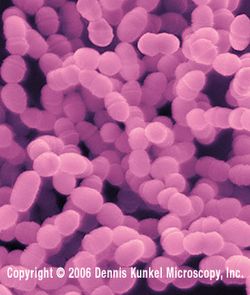
Streptococcus mutans is a type of bacteria called a pathogen. A pathogen is a type of disease producing agent. This particular pathogen causes tooth decay. It is also Gram-positive. This means that when a gram stain is applied to the bacteria, it appears purple. This is because of the peptidoglycan contained in the cell walls. The existence of peptidoglycan in the cell walls renders this type of bacteria a member of the kingdom Eubacteria. Streptococcus mutans’s appearance can be described as scattered and clumped chains of bead-like ovals. It falls under the bacilli shape category. It was first described by JK Clark in 1924 at St. Mary’s hospital in London. He reported that the type of bacteria most frequently found in cavities and most likely to causes tooth decay was Streptococcus mutans. Clark demonstrated that Streptococcus mutans is one of the most virulent decay-producing organisms. This pathogen is commonly found in the human mouth and is a significant contributor to tooth decay. Here’s how it works; sugars such as glucose, fructose, and lactose can be digested by S. mutans and produce lactic acid as an end product. This acid along with plaque is what eventually leads to dental decay. There have been many attempts to create a vaccine against this pathogen. However, no vaccines have been successful in humans. Scientists still have much work to do to fully understand this complex pathogen.
Wednesday, December 22, 2010

Tuesday, December 21, 2010
Goodbye, Mr. Chips.
There ain't an American who doesn't love a good lip-smacking potato chip. Recently scientists (*cough* ME *cough*) have been analyzing the psychological impacts of your favorite flavor of this popular crunchy snack.
Classic- Classic Potato chips are for the kind of people who also enjoy original bubblegum and clear streams of running water. They also enjoy lukewarm roasted marshmallows that are barely even yellowed. If you like Classic then you are the type of friend someone can count on when they are in a pinch. But if they want you to come TPing with them, you suddenly have a HUGE honors bio test you have to study for.
Sodium-free – If your favorite bag of chips is sodium-free you either had your taste-buds removed or you are dead.
BBQ- This sweet-and-tangy combo is perfect for those who love high-top sneakers and spray-painted chiwahas. And also for those people who cannot spell chiwahas. (You know, the Mexican rat dogs?)
Sour Cream and Onion- Blech. That’s all I can say.
Fish and Chips- Um, your fave “flavour” isn’t even a chip. Sorry – it’s a fancy name for deep fried fish/potato mush. Yeaaaah, sour cream and onion is starting to sound super delish right now. Better head back to London, mate. Bonjour, or whatevs.
Salt & Vinegar- If you enjoy this type of chip then you are the type of guy who looks like he’s all ready for Sunday school but secretly wishes he was dying his hair green with Kool-Aid and starting a band in his garage. C’mon, this thing doesn’t lie – you know you want too!!
Wrinkled – I can never remember what they call this kind of chip? Ripped? Rippled? Ripe-eld? Whatever. It’s basically a variation of Classic. It’s like drawing a stick figure on a refrigerator box and calling it a masterpiece. LIES I TELL YOU.
*sigh* It's a food post. Now what does that tell you? (I'm a woman, I'm hungry and I'm craving chips)
Wednesday, December 15, 2010
Welcome to the Rain Forest!

Breathe in warm, moist air, smell hot animal dropping and hear the screeching of a toucan. Take a single step into the steamy jungle and hear the hiss of an anaconda and the scurrying of a squirrel monkey. Look up at the deep emerald celling that seeps with moisture and sunshine and sigh into the heavy air. Home to tall trees, the most species in the world and as much as one inch of rain a day, welcome to the rainforest! This is the biome that has captured the imaginations of filmmakers and the hearts of environmental activists.
Tropical rainforests are made of very tall trees – many of which are 70 meters above the ground! They from a dense covering called the canopy. In the section below the canopy, we have the understory. This is an area of shorter trees and vines. Organic matter falls to the forest floor regularly and it quickly decomposes and the nutrients are recycled. A rainforest resembles a tangled green mess. It’s abiotic factors include hot and wet weather all year round, and thin, nutrient poor soils.
Dominant plants in the tropical rainforest are broad-leaved evergreen trees, ferns and large woody vines/climbing plants. Also popular are beautiful orchids and bromeliads. These plants are inhabited by a variety of different animals. In fact, the tropical rain forest has more species than any other biome on earth! Some of the dominant herbivores include slots, tapir and capybaras. Common predators are jaguars, anteaters, monkeys, birds (toucans, parrots, parakeets), butterflies, ants, and piranhas. Reptiles are also found in the rainforest, mostly caymans, boa constrictors and anacondas.
If you wanted to visit a tropical rain forest, you would have to travel to parts of south and central America. You could also find one in south-east Asia, or southern India. Last but not least, you could also find tropical rainforests in northeastern Australia. If you want to take a trip to a rainforest, be careful, because they are full of dangerous and poisonous creatures! They are drenched in pests that often carry diseases such as malaria. However, if you are a serious scientist looking to study a large and interesting ecosystem, this could be for you!
 |
| LOOK OUT FOR THE KILLER GUY! |
Tuesday, December 14, 2010
My Niche
Because I'm such a productive person, I blew threw so much biology I'm on to the next item to be posted on my blog. No, not another Van Gogh worthy poster. Actually, I wish it was that simple. Question # 35 in my assessment asked me to "Write a description of your niche in the environment. Include details about your ecosystem, including the biotic and abiotic factors around you. Be sure to describe your feeding habits as well as any interactions you have with members of your species."
Great. Now "they" will find me.
Okay, here's a rundown. My name is Mary Di Valerio and I am of the species "homo Teenagerious." This species is typically one of the more ridiculed species, because they are one of the few groups of people on earth who would rather rant about fictional characters and correspond with a glass screen rather than take a warm bath and crawl into a toasty bath. In general, members of "homo Teenagerious" are reckless and uncontrollable when they come into contact with substances such as sugar, cheese and caffeine. Their habitat consists of small dens that vaguely resemble the television show "Hoarders." The bedrooms of "homo Teenagerious" are by far dirtier, smellier and sloppier, however. When entering such a habitat, proceed with caution. The rooms may contain unprecedented amounts of junk food and Japanese soldiers who think WWII is still in progress.
Their eating schedule consists thus: three meals a day plus about four billion snack breaks in between.
Interactions with members of the species are brief and to the point. If you are lucky the "homo Teenagerious" may even grunt! Members of this species are very shy and prefer to do their business over a very sacred ritual called "Facebook."
Some elite members of "homo Teenagerious" undergo intense mating rituals in which they exchange saliva and touch palms.
Some biotic features include clumps of fuzzy mold in the corners of their bedrooms and that's about it. They prefer to interact with technology rather than living organisms.
I hope you were paying attention, as there will be a test on Monday.
Great. Now "they" will find me.
Okay, here's a rundown. My name is Mary Di Valerio and I am of the species "homo Teenagerious." This species is typically one of the more ridiculed species, because they are one of the few groups of people on earth who would rather rant about fictional characters and correspond with a glass screen rather than take a warm bath and crawl into a toasty bath. In general, members of "homo Teenagerious" are reckless and uncontrollable when they come into contact with substances such as sugar, cheese and caffeine. Their habitat consists of small dens that vaguely resemble the television show "Hoarders." The bedrooms of "homo Teenagerious" are by far dirtier, smellier and sloppier, however. When entering such a habitat, proceed with caution. The rooms may contain unprecedented amounts of junk food and Japanese soldiers who think WWII is still in progress.
Their eating schedule consists thus: three meals a day plus about four billion snack breaks in between.
Interactions with members of the species are brief and to the point. If you are lucky the "homo Teenagerious" may even grunt! Members of this species are very shy and prefer to do their business over a very sacred ritual called "Facebook."
Some elite members of "homo Teenagerious" undergo intense mating rituals in which they exchange saliva and touch palms.
Some biotic features include clumps of fuzzy mold in the corners of their bedrooms and that's about it. They prefer to interact with technology rather than living organisms.
I hope you were paying attention, as there will be a test on Monday.
 |
| Photograph of typical teenager |
Subscribe to:
Posts (Atom)