 |
| Pollen on a Bee |
Wednesday, February 16, 2011
Pollination
After the gametophytes have developed, pollination occurs. Most gymnosperms and some angiosperms are win-pollinated by animals. These animals, mainly insects, birds and bats carry pollen from one flower to another. Because wind pollination is less efficient than animal pollination, wind-pollinated plants, such as the oak tree rely on favorable weather and sheer numbers to get pollen from one plant to another. Animal-pollinated plants have a variety of adaptions, such as bright colors and sweet nectar to attract animals. Animals have developed behaviors to help them find flowers. They have also evolved body shapes that enable them to reach nectar deep w/in certain flowers.
Insect pollination is adaptive because it increases the fitness of both organisms. It is beneficial to insects and other animals because it provides a dependable source of food. The food may take the form of pollen itself or the sugar-rich liquid called nectar. Plants also benefit because the insects take their pollen directly from flower to flower. Insect pollination is much more efficient than wind pollination, giving insect-pollinated plants a higher probability of reproductive success In fact, many plant biologists suggest that the angiosperms displaced the gymnosperms so throughly during the past 100 in part becaue of insect pollination.

Long and Glorious Life Cycles of Angiosperms
Reproduction in angiosperms takes place within the flower. Following pollination and fertilization, the seeds develop inside protective structures.
The angiosperm life cycle begins when the mature sporophyte produces flowers. Each flower contains anthers and an ovary. Inside the anthers, the male part of the flower, each cell undergoes meiosis and produces four haploid spore cells. Each of these cells becomes a single pollen grain. The wall of each pollen grain thickens, protecting protecting the contents of the pollen grain from dryness and physical damage when it is released from the anther.
The nucleus of each pollen grain undergoes one mitotic division to produce two haploid nuclei. The pollen grain, which is the entire male gametophyte, usually tops growing until it is released from the anther and deposited on a stigma.
The ovary of the flower contains the ovules in which the female gametophyte develops. A single diploid cell goes through meiosis to produce eight nuclei. These eight nuclei and the surrounding membrane are called the embryo sac. The embryo sac, contained within the ovule, is the female gametophyte of a flowering plant. One of the eight nuclei, near the base of the gametophyte, is the egg nucleus, the female gamete. If fertilization takes place, this cell will become the zygote that grows into a new sporophyte plant.
The Marvelous Science of Girliness
Many people mistakenly believe that flowers and sunshine are simple things for nincompoops. Boy, are they ever wrong. The science of girliness is actually quite complex. Take the structure of a flower, for example.
Flowers are intricate reproductive organs that are composed of four kinds of specialized leaves. They are SEPALS, PETALS, STAMENS AND CARPELS.
Sepals and petals: The "sterile" leaves
The sepal is located in the outermost circle of floral parts. It is usually green and looks like your ordinary leaf. But do not be fooled! Sepals are anything but ordinary. They enclose the bud before it opens, and protect the flower while it develops. They do not produce reproductive cells so they are called sterile leaves, just like their neighbors, the petals! Petals are often brightly colored and are found located right inside the sepals. The petals work to attract insects and other pollinators to the flower.

Stamens and Carpels: The "happy couple" leaves
W/in the ring of petals are structures that produce the male and female gametophytes. A gametophyte is the haploid or gamete-producing phase of an organism. Haploid is a term used to refer to a cell that contains only a single set of chromosomes and therefore only a single set of genes. The male parts consist of an anther and a filament, which together make up a stamen. The filament is a long thing stalk that supports an anther.
An anther is an oval sac where meiosis takes place, producing haploid male gametophytes-- pollen grains. In most angiosperms, each flower has several stamens. If you run your hand on the anther of a flower, a yellow dust may stick to your skin. This is pollen which consists of thousands of of individual pollen grains.
Th intermost floral part is the carpels, aka pistils. They are the female part of the flower. Each carpel has a broad base forming an ovary which contains one or more ovules where female gametophytes are produced here.
The diameter of the pistils narrow into a stalk known as the style. At the top of the style is a sticky portion known as the stigma. This is where pollen grains usually land. Some flowers have several pistils fused together to form a compound carpel.
In conclusion: Flowers are very different and quite beautiful. A typical flower produces both male and female gametophyte. In some plants, however, male and female gametophyte are produced in separate flowers on the same individual. Corn, for example, has separate male and female flowers on the same plant. The tassel is a flower that produces male gametophytes and the silk is the style of a flower that contains the female gametophyte. In other cases many flowers grow together to form a composite structure that looks likes a single flower. A good example of this is the sunflower.

Flowers are intricate reproductive organs that are composed of four kinds of specialized leaves. They are SEPALS, PETALS, STAMENS AND CARPELS.
Sepals and petals: The "sterile" leaves
The sepal is located in the outermost circle of floral parts. It is usually green and looks like your ordinary leaf. But do not be fooled! Sepals are anything but ordinary. They enclose the bud before it opens, and protect the flower while it develops. They do not produce reproductive cells so they are called sterile leaves, just like their neighbors, the petals! Petals are often brightly colored and are found located right inside the sepals. The petals work to attract insects and other pollinators to the flower.
Stamens and Carpels: The "happy couple" leaves
W/in the ring of petals are structures that produce the male and female gametophytes. A gametophyte is the haploid or gamete-producing phase of an organism. Haploid is a term used to refer to a cell that contains only a single set of chromosomes and therefore only a single set of genes. The male parts consist of an anther and a filament, which together make up a stamen. The filament is a long thing stalk that supports an anther.
An anther is an oval sac where meiosis takes place, producing haploid male gametophytes-- pollen grains. In most angiosperms, each flower has several stamens. If you run your hand on the anther of a flower, a yellow dust may stick to your skin. This is pollen which consists of thousands of of individual pollen grains.
Th intermost floral part is the carpels, aka pistils. They are the female part of the flower. Each carpel has a broad base forming an ovary which contains one or more ovules where female gametophytes are produced here.
The diameter of the pistils narrow into a stalk known as the style. At the top of the style is a sticky portion known as the stigma. This is where pollen grains usually land. Some flowers have several pistils fused together to form a compound carpel.
In conclusion: Flowers are very different and quite beautiful. A typical flower produces both male and female gametophyte. In some plants, however, male and female gametophyte are produced in separate flowers on the same individual. Corn, for example, has separate male and female flowers on the same plant. The tassel is a flower that produces male gametophytes and the silk is the style of a flower that contains the female gametophyte. In other cases many flowers grow together to form a composite structure that looks likes a single flower. A good example of this is the sunflower.

Tuesday, January 11, 2011

T4 Bacteriophage
 |
| The red section is supposed to be a cut-out. Inside you can see green squiggles and that is supposed to be the DNA. |
Streptococcus Mutans
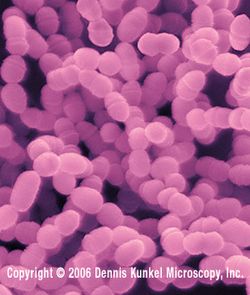
Streptococcus mutans is a type of bacteria called a pathogen. A pathogen is a type of disease producing agent. This particular pathogen causes tooth decay. It is also Gram-positive. This means that when a gram stain is applied to the bacteria, it appears purple. This is because of the peptidoglycan contained in the cell walls. The existence of peptidoglycan in the cell walls renders this type of bacteria a member of the kingdom Eubacteria. Streptococcus mutans’s appearance can be described as scattered and clumped chains of bead-like ovals. It falls under the bacilli shape category. It was first described by JK Clark in 1924 at St. Mary’s hospital in London. He reported that the type of bacteria most frequently found in cavities and most likely to causes tooth decay was Streptococcus mutans. Clark demonstrated that Streptococcus mutans is one of the most virulent decay-producing organisms. This pathogen is commonly found in the human mouth and is a significant contributor to tooth decay. Here’s how it works; sugars such as glucose, fructose, and lactose can be digested by S. mutans and produce lactic acid as an end product. This acid along with plaque is what eventually leads to dental decay. There have been many attempts to create a vaccine against this pathogen. However, no vaccines have been successful in humans. Scientists still have much work to do to fully understand this complex pathogen.
Wednesday, December 22, 2010

Subscribe to:
Posts (Atom)